



Aug 26, 2026 Small Business Resources
MTD for Income Tax: auto-sign up, penalties and getting ahead
- uk
Table of Contents
Aug 15, 2026
Last updated: Sep 19, 2026
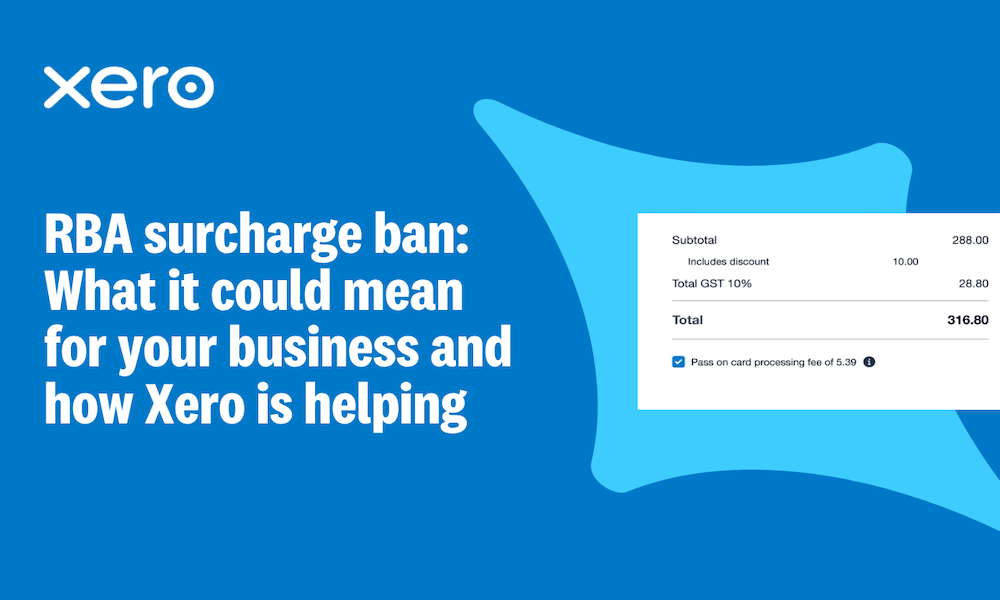
From 1 October 2026, Australian businesses will no longer be able to add a surcharge to eftpos, Visa, Amex or Mastercard payments.
The Reserve Bank of Australia is removing the ability for businesses to pass card processing fees directly on to customers. The change will be enforced through the card networks themselves, so the option to add a fee at checkout will no longer be available for those card types.
If you currently pass on some or all of your card fees, each sale will cost you slightly more.
For some businesses, the surcharging removal will be a small change. For others, it will affect margins, pricing and cash flow. Either way, it’s critical you don’t wait until October to work out what it means for your business.
From 1 October, Xero is reducing our domestic card fee on Stripe for Australian businesses from 1.8% + A30c to 1.75% + A30c per transaction (all prices include GST). With surcharging no longer available, reducing our fee is our way of helping ease some of the pressure.
This change will automatically apply to your Stripe account(s) in Australia with pricing and fees managed by Xero (including invoices already issued). There’s nothing you need to do.
If you use Xero to send invoices with a card surcharge applied, this will stop automatically on 1 October. Card payments will continue working as normal, but your customers will no longer be charged the processing fee on top and it will disappear from the invoice.
Any unpaid invoices already out with a surcharge on them will also be updated. When your customer pays on or after 1 October, they’ll pay the invoice amount without the fee added.
The option to pass on processing fees will also disappear from your Online payments settings. If you’d prefer to stop surcharging before the deadline, you can turn it off yourself anytime.

For many small businesses, the ability to pass on card fees is not just about covering costs, but is a part of a larger set of decisions on what payment methods to offer. Things like how you price, what payment methods your customers expect, and how that impacts when you get paid. This flows on to admin, time you spend chasing payments, and reconciliation.
There isn’t a single right approach for every business – it will depend on your margins, your customers and how you compete.
Here are some paths worth thinking through before October. Your accountant or bookkeeper is the best person to help you think through a pricing or cash flow change like this. They know your numbers better than anyone. Consider setting up a conversation with them before October, as you’re thinking through your plan.
Work the fee into your list price or hourly rate rather than adding it at checkout. This is simple for your customers to understand, though price rises might not be competitively viable for some businesses.
The RBA has been clear that this isn’t just a naming exercise and you can’t use a “cash discount” or “card handling fee” as a workaround. Whatever path you choose, make sure it’s a genuine pricing decision.
Businesses using online payments can get paid up to 2x faster – the fee is small compared to the time savings from faster payments and reduced chasing and admin time.
Getting paid in two days by card instead of chasing an invoice for three weeks has a real value in admin time and in your own cash flow.
Features such as deposits and statement payments can help you secure payment upfront or collect multiple invoices in one go.
The value is not only in accepting the payment; it’s also in the time saved and the smoother cash flow that can follow. It’s worth looking at the total cost of getting paid, not just the processing fee in isolation.
Choice matters to your customers; 86% of consumers say they would rather pay by card.* If they can pay however it suits them, they are more likely to pay on time.
The more ways you give customers to pay, the more you can shift the overall mix toward lower cost methods. Direct debit and PayTo, for example, typically carry a lower processing fee than card payments and settle quickly, so you’re not trading speed for cost savings.
*Survey conducted by Xero of 6,021 consumers and 2,547 small businesses globally using Xero, May 2024

You're on our global website. Change your region to see information and pricing for another location.