




Oct 17, 2026 News & Events
Table of Contents
Jul 31, 2026
Last updated: Aug 6, 2026
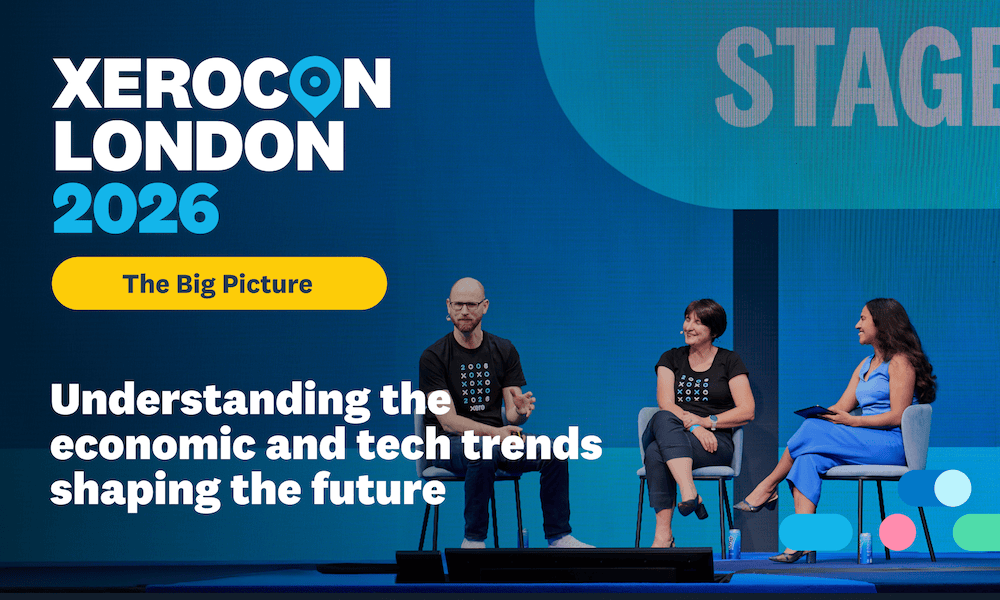
Every week brings a headline that AI is about to change everything and, often in the same breath, another warning the economy is about to fall over. If you advise small businesses, the hard part isn’t necessarily following the news but finding the time to work out what any of it might mean for you and your clients.
At Xerocon London, we sat down to try to do exactly that – finding a way of cutting through the noise to understand the bigger picture. And while the two of us come at the future from different perspectives, it turns out that exploring both the technological and economic trends in tandem does in fact help with making sense of it all.
We spend our working lives looking at the same questions about trends and the future from different vantage points. Louise, as our Global Economist, reads through history and economic data to understand the shape of things. James, as our EGM Technology Research and Advocacy, focuses on strategic foresight when examining tech trends and innovation. We each reach first for one thing – precedent or signals (we’ll let you guess who!) – even though we both do plenty of both. Combined, the two lenses give a fuller picture than either offers alone.
Take productivity, the word sitting underneath almost every question and conversation about AI right now. Louise’s read: It is true that businesses using AI are reporting real gains. But it is also true that many of those gains haven’t shown up in the economy-wide statistics yet. Both things can be right at the same time. It echoes a puzzle the economist Robert Solow identified back in 1987: “you can see the computer age everywhere but in the productivity statistics.” Swap “AI” for “computers” and it could have been written this morning. The lag is normal. It took the best part of a decade for computers to surface in the figures. So when someone tells you this moment is “unprecedented,” that’s usually a reason to be more skeptical, not less.
James’ read starts further out: What kind of tech change is this, exactly? Sometimes technology improves in a steady climb, like the efficiency of solar panels or the number of megapixels in your phone camera. A smooth escalator advancing upward. But sometimes it moves in discrete jumps, shaped more like an s-curve shift that rewrites the rules fast. So, when it comes to this group of AI technologies, is the progress we are seeing aligned to what MIT calls a ‘rising tide’, lifting all capability by similar amounts and giving markets time to adapt? Or is it more akin to a ‘crashing wave’, uplifting capability at a different pace for different long-running tasks? The reality is that we won’t really know the type of change we are facing until we can look back. What we do know is that underneath all the capability on offer, these tools are maths, not magic, with real limits on anything that needs taste, judgement, or human context.
For all the differences in our starting points, we tend to land in the same place: we’re more likely in a period of adjustment, not an apocalypse. The picture since 2022 is disproportionately one of reshaping jobs as tasks within roles shift, some use cases are affected more than others, and entry-level roles are a particular point worth watching. But role redesign is running well ahead of outright displacement. What proves durable is the part no model can replicate. The stubbornly human qualities of context, judgement, and making the call on what should happen, not just what could.
As seen at Xerocon London 2026 — UK Modern Practice Playbook 2026
We each have a version of what to do with all of this. James takes his inspiration for action from the All Blacks and the ABCs: assume nothing, examine your blindspots, keep a change mindset. This is how he thinks about any kind of tech change, and is a way for looking to the horizon whilst thinking about what we can do in the present to shape the future we prefer.
Louise’s is just as portable: how a business lifts its productivity doesn’t change with the technology. It still comes down to understanding your processes, using the best tools for the job, and training your people. The fundamentals hold, whatever the headline on the front page.
Cutting through the noise is a skill that benefits from looking at both the technical and economic perspectives, especially when the next headline is already on its way and the next trend is already forming. And, remember, you have more agency than the headlines suggest to stack the odds toward the future you’d prefer.
We’ll keep exploring this as part of our everyday jobs, and we’re excited to talk more about this with many of you at Xerocon Denver and then on the road through the year. The more we explore these trends and signals together, the better we can all make sense of the moment.
You're on our global website. Change your region to see information and pricing for another location.