



Aug 4, 2026 Data & Insights
What the World Cup taught restaurant owners about preparing for growth
- us
Table of Contents
May 18, 2026
Last updated: May 28, 2026
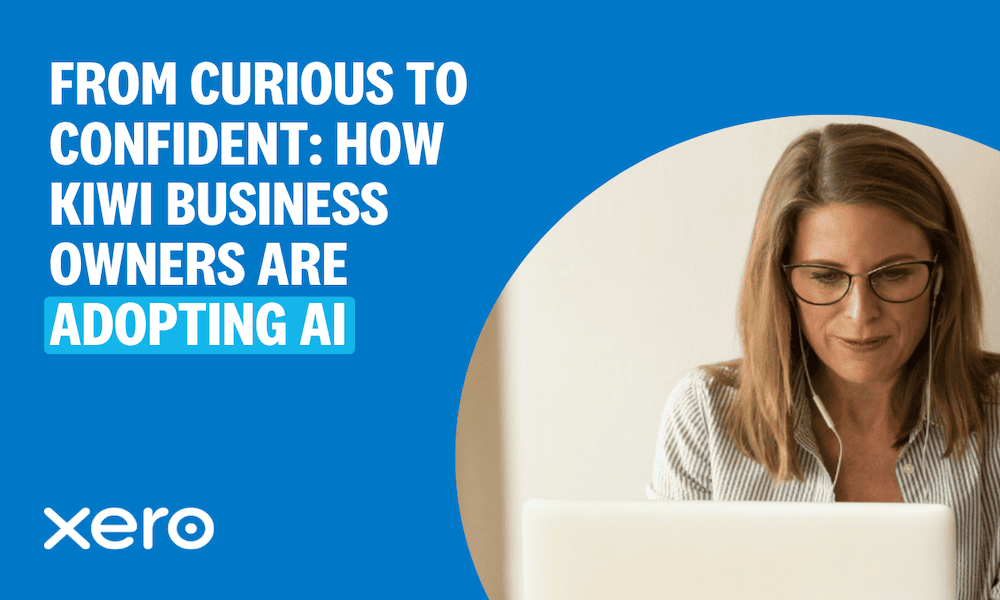
When it comes to AI, small and medium businesses are less interested in some of the more theoretical debates about whether it matters. What they’re grappling with is how and where to use AI safely and confidently to unlock more meaningful value.
This, among others, was one of the key findings from Xero’s latest research examining Kiwi small and medium businesses’ use of and attitudes towards AI in 2026.
We found that nearly half (45%) of small and medium businesses believe that AI could be the most significant opportunity since the rise of the internet. Yet, despite this high-level hope, a deep-seated confidence gap could be holding some business owners back.
The findings go beyond the typical hype to uncover the lived reality for Kiwi small and medium businesses. It’s not a story of resistance, but one of resource constraints: a lack of time, trust in platform privacy and data protections, and a clear roadmap for implementation.
According to our research, nearly two-thirds (61%) of small and medium businesses are proactively* using AI technologies. Among them, most (79%) are learning through self-guided experimentation.
To better understand what’s driving this decision – the choice to use or not use AI technologies – we uncovered four distinct archetypes, each representing a set of beliefs that influence how they approach AI adoption.
Importantly, these archetypes can help us identify opportunities. In acknowledging that everyone has different views, motivations and needs, we can accept that how small and medium businesses use AI will look different – and that this could change over time.
So, instead of a ‘one size fits all’ approach, these archetypes point to possibilities by asking: what could move the needle on how business owners utilise AI?
Explorers represent the largest group of Kiwi small and medium businesses at 44%. The vast majority (99%) use AI tools for specific tasks within their business, and most claim to have a good working knowledge (57%) or a basic understanding (39%) of AI technologies.
They’re motivated by saving time and making work easier (40%), and are among the most likely to increase AI use over the next 12 months (58%).
Explorers are curious, practical, and willing to try new tools. However, their approach is largely experimental and self‑guided (55%), layering AI onto existing ways of working rather than rethinking processes altogether.
The opportunity we see for Explorers: Move away from ‘bolting on’ AI tools to specific tasks and start ‘baking them in’. This could mean developing a deeper understanding of your business processes to better target AI deployment, or more experimentation to reimagine workflows with an AI-first lens.
Sceptics represent just over a quarter (26%) of small and medium businesses. They’re unconvinced on AI’s potential, with almost half (44%) believing it isn’t relevant to their business.
Of all the archetypes, they have the highest levels of concern – valid ones, at that – about risks such as data privacy and security (47%) and the accuracy of AI outputs (46%). Given this, most (89%) have no plans to invest in AI in the near term.
While some (12%) acknowledge that AI could help with simple automation when used carefully, this group is cautious about unintended consequences, such as a loss of ‘human connection’ and over‑reliance.
The opportunity we see for Sceptics: Without ignoring the concerns around some types of AI, small mindset shifts – to whatever extent you feel comfortable – could present green shoots of opportunity. Whether it’s talking to other business owners about how they tailor AI implementation, or taking another look at your end-to-end business processes to identify specific opportunities that align to the capabilities on offer, knowledge and guardrails could be key to building confidence.
Representing 15% of small and medium businesses, Trailblazers are the early adopters of AI technologies. They’re the most likely to use AI tools extensively (83%), and almost two-thirds (65%) believe AI capabilities have the power to truly revolutionise the way their business operates.
Trailblazers are also the most likely to agree on the benefits of AI technologies, reporting tangible gains in productivity (76%), time savings (71%), and improved decision making (47%). So it makes sense that most (91%) plan to increase their use of AI tools within the next 12 months.
The opportunity we see for Trailblazers: Ensure your focus isn’t just on chasing the newest, hyped-up tool and deploy some of your efforts towards mastering the strategic integration of what you already have. The real opportunity isn’t just doing things faster or using as much AI as possible, but rather using a purpose-fit, context-aligned AI stack to realise even greater benefits within your business.
Pragmatists also comprise 15% of small and medium businesses. They largely believe AI could be useful; 78% have started exploring or testing AI tools, or plan to utilise them within the next year.
However, it’s not a lack of interest that’s stopping them from doing more with AI tools; rather, it’s a lack of time to properly investigate and experiment with them. In fact, they’re the most likely to cite time as the biggest barrier to adoption (55%).
The data shows that Pragmatists are less driven by leveraging AI technologies to unlock competitive advantages (5%) and appear more motivated by the promise of lower stress and better work‑life balance (25%).
The opportunity we see for Pragmatists: View the time spent learning AI not as a ‘cost’ that takes you away from work, but as a ‘capital investment’ that buys back future time. Focusing on optimising the right processes could mean five hours spent today saves five hours every week – a worthy trade-off, indeed.
To take advantage of these opportunities across all archetypes, there’s a strong desire from small and medium businesses to see more AI governance and practical support.
When asked what role the Government should play in encouraging AI adoption among small and medium businesses, the top responses were to set clear regulations and accountability standards (57%), and to enforce strong data protections and standards (55%). One in three also want Government to provide education and training resources.
As for what would help business owners feel more confident in deploying AI, similar themes emerge in practical training and workshops (47%), access to trusted, vetted tools built specifically for small and medium businesses (46%), and real-world case studies showing how others are using AI (43%).
This clear call for help is why Xero has partnered with ASB to launch a fully funded, 12-week online AI bootcamp for Kiwi small and medium businesses, delivered by academyEX.
The online programme is designed to help business owners build real‑world skills and capability to turn emerging tools into practical, productivity‑boosting parts of their everyday operations, with limited places available via an expression‑of‑interest process.
It’s clear that small and medium businesses believe AI tools can help them – many just want to be sure they’re using them in the right way. The desire is there; the next step for many is gaining knowledge and confidence, according to our research. Whether that means narrowing focus to avoid the hype, or carving out the time to deepen experimentation and learning, exploring ways to unlock value with AI – whatever that may look like for your business at this point in time – is a worthwhile endeavour.
*For the purpose of this research, when we refer to AI, we mean any AI-enabled tool or platform that a small or medium business has actively adopted with the intention of adding or creating value.
Learn more about Aotearoa’s largest online AI Bootcamp for small and medium businesses, brought to you by Xero and ASB, delivered by academyEX, New Zealand’s postgraduate institute built for the age of disruption.
You're on our global website. Change your region to see information and pricing for another location.