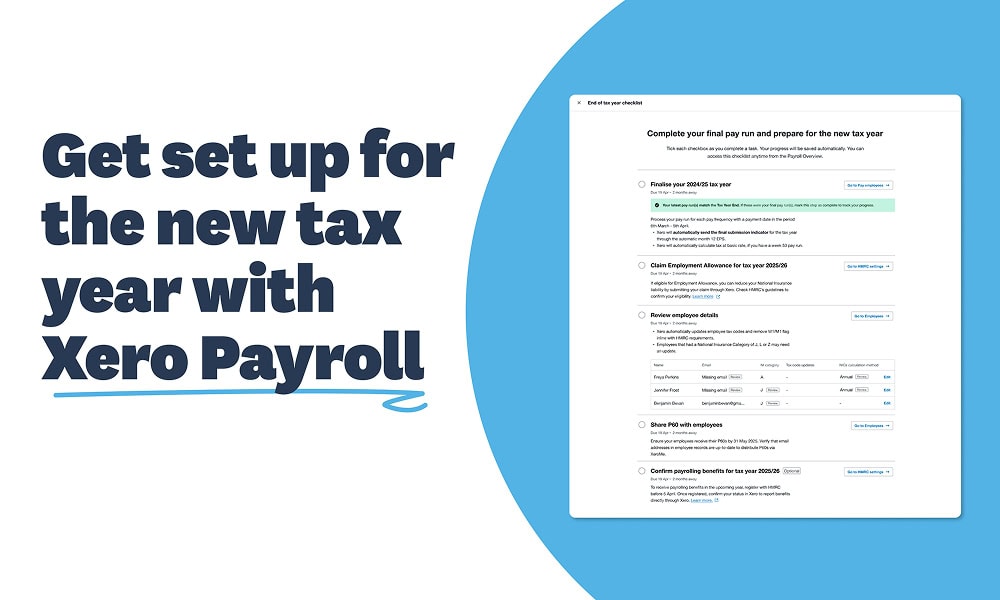
With another tax year almost wrapped up, are you ready to tackle year-end payroll? We know it can be a bit painful, so we’ve prepared some tips to make the process as smooth as possible.
Finalising your 2025/2026 tax year
Wrap up outstanding items
Before processing your last pay run for the 2025/26 tax year, approve any outstanding leave requests, timesheets and overtime to ensure your employees’ final pay is accurate.
Double-check payroll reportings
Review key reports like the P32, P11s, Gross to Net, and Account Transactions to ensure your posted pay runs are reconciled.
If you’re in the construction industry, don’t forget to review and reconcile your Construction Industry Scheme (CIS) Suffered report for the tax year.
Posting your final pay run
There’s a few things to consider when posting your final pay run:
- Ensure your final payment date falls between 6 March – 5 April 2026.
- If you run weekly payroll, you may have a week 53 this year—don’t worry, Xero will handle this automatically.
- Xero will submit an Employer Payment Summary (EPS) to HMRC once your final pay run is complete.
- If you’re not paying employees, post a NIL pay run to trigger an EPS.
- If you need to make any changes after processing the pay run, you have until 19 April 2026 to make any adjustments.
- Provide employees their annual tax summary (P60s). Review the P60 reports, once you’re happy that all year to date payments are included, share P60s with your employees by 31 May 2026 via Xero Me.
Get ready for 2026/27 tax year
We’ve put together a payroll facts and figures guide for 2026/27 to help you navigate the new tax year.
Use our handy checklist in Xero Payroll > Payroll Overview to update your settings before running your first 2026/27 pay run.
Key updates to check:
Employment allowance
If you’re eligible, activate it in Payroll Settings > HMRC tab.
National Insurance
Review director National Insurance calculation methods and keep an eye out for employees on any deferment certificates who may need to be updated. If you have employees working in a UK freeport, investment zones, or who are qualifying veterans, you might be able to claim relief by updating their category letter.
Tax codes
Tax codesIf you were on a W1/M1 tax code, Xero will switch you back to the normal tax method at the start of the new tax year. Any tax code updates from HMRC (also known as P9X) will be automatically applied in Xero.
Corporation Tax UTR for CIS suffered
If you’re in the Construction Industry and claiming CIS suffered, enter your Corporation Tax UTR in Payroll Settings > HMRC tab. If it’s not already there, you’ll be prompted to add it when scheduling your next Employer Payment Summary (EPS) and entering an amount of CIS suffered.
Payroll benefits
From April 2027, a new UK government mandate will require employees’ benefits (like company cars, insurance) to be reported via payroll, meaning you won’t need the P11D form across most benefits. It’s a good idea to start doing it now.
- If you offer these benefits, register with HMRC before the new tax year.
- For benefits you’re already payrolling in Xero Payroll, check their values and availability dates for the new tax year.
- For company cars or vans, leave the “available to” date blank if employees are keeping them—Xero will roll them over automatically.
- By 6 July 2026, submit your P11D(b) form to report any National Insurance due on these benefits.
- Employers won’t need to include loans or accommodation in payroll right away, this will be optional from April 2027.
New payroll changes to consider for the 2026/27 tax year
Bereavement leave for Northern Ireland
From 6 April 2026 Statutory Bereavement leave has been extended to accommodate a new Northern Ireland scheme.
- Inclusion of Miscarriage: The new scheme extends the entitlement for leave and pay to cover miscarriage (at any stage before 24 weeks) if they are gainfully employed in Northern Ireland.
- If the employee is gainfully employed in Northern Ireland and they are claiming Statutory Parental Bereavement Pay (SPBP), the employees workplace post code is required.
- The entitlement is for 2 weeks which can be taken non-consecutively.
- Entitlements for Miscarriage: The 56-week entitlement period begins from the date the person “became aware of the miscarriage” (i.e. the period of time the leave must finish is within 56-weeks).
- Under the new NI rules, Statutory Parental Bereavement Pay (SPBP) becomes a “day one” right, just like the leave entitlement. This removes the current requirement for 26 weeks of continuous employment to qualify for pay (in Northern Ireland).
- New “Expected Earnings” Calculation: To support the “day one” pay right, the method for calculating Average Weekly Earnings (AWE) is new. It introduces a 16-week “relevant window” and allows employees to qualify for pay based on actual earnings (before the bereavement), expected earnings (after the bereavement), or a combination of both.
SSP reform
- Removal of the Lower Earnings Limit (LEL): All employees, regardless of how much they earn, will be eligible for SSP. Currently, employees must earn at least the LEL (which is £125 per week for 2025/26) to qualify.
- Removal of ‘waiting days’. SSP will be payable from the first day of sickness.
- New Calculation Method: SSP will be calculated as the lower of:
- 80% of the employee’s average weekly earnings (AWE), or
- The flat weekly SSP rate to be £123.25 from April 2026.
Student Loan plan 5
- This new plan will operate in the same manner as Plans 1, 2, and 4. The earliest payment date for student loan deductions under this plan is 06/04/2026.
- Deductions for repayments will be made at 9% on earnings over an initial threshold of £25,000.
Upcoming changes from April 2026
- The UK government announced updates to mandate the reporting of benefits in kind through payroll software, in real time, from April 2027. It will be introduced in a phased approach, requiring employers to payroll most benefits initially, Employers will not be required to payroll loans and accommodations initially.
- EYU (Earlier Year Update) will no longer be accepted by HMRC from 6th April 2026. The final tax year for which corrections can still be made by EYU is 2019/20.
- Small Employers Relief has been increased to 109%
- LEL has increased to £129 per week, £559 per month, £6708 per year
- NMW updated hourly rates – Apprentice £8.00, Under 18 £8.00, 18-20 £10.85 and 21 & over £12.71
- State Pension Age phased increase from 66 to 67 for anyone born between 6/4/60 & 5/4/77
Launching soon – Pay employees directly from Xero
Pay your team straight from the pay run using open banking, with no more downloading bank files or copying and pasting payment data between systems. Rolling out now, payroll and payments will happen together in Xero, reducing manual handling and the uncertainty that comes with it.
Approve the pay run, authorise the payment and you’re done. Payments will be initiated directly from validated payroll data, helping ensure everything is correct before money leaves your account and employees are paid accurately and on time.
Powered by trusted open banking technology, this feature represents an important step towards faster, more secure and more reliable payroll payments.
Was this article helpful?
YesNo